Seabirds
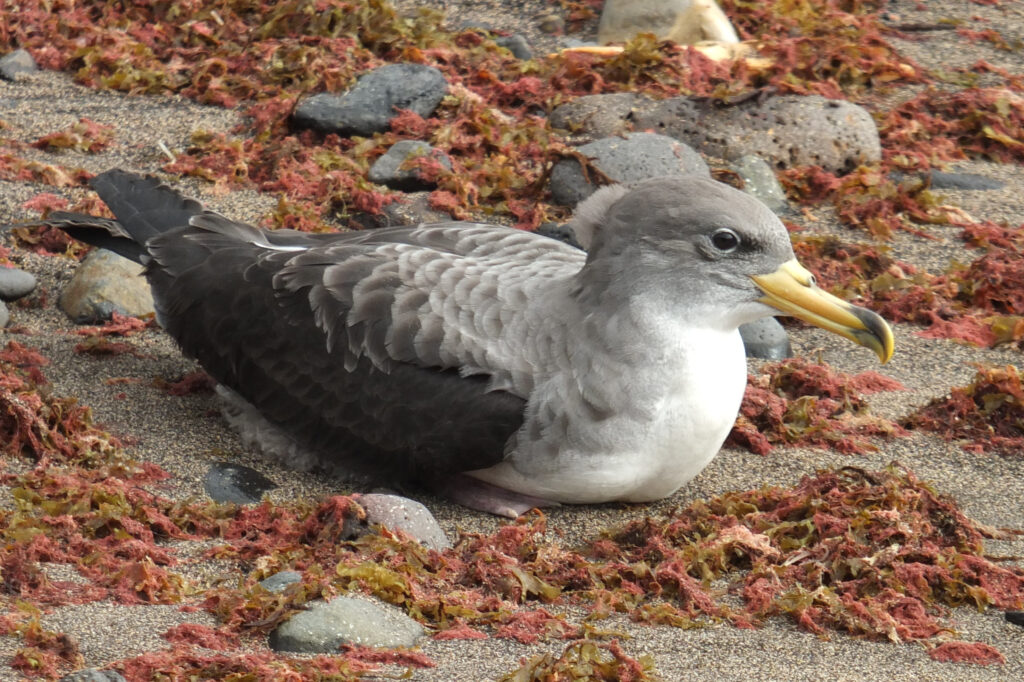
I confess to being an addict; an addictive seawatcher. In fact I am a ‘Cagarro’, the Portuguese representation of the weird call of the Cory’s Shearwater, heard over the islands in the Azores on summer nights. There is a particularly large breeding population on Santa Maria and the islanders, and anyone who has lived on the island, is labelled a Cagarro.
Hundreds of these large shearwaters get stranded on land and the Environment Office on Santa Maria rescue and rehabilitate them each year, returning them to the sea. This individual on the beach was rather reluctant to leave.
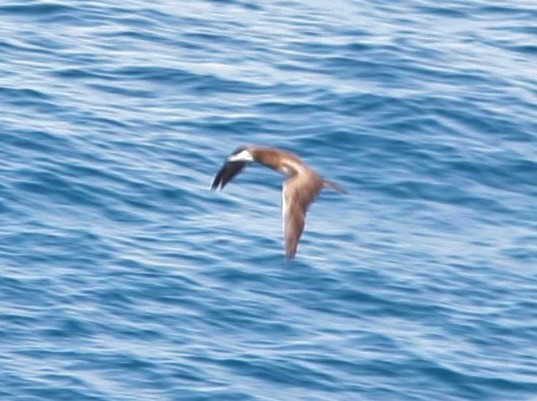
I do not attempt to take photos on seawatches, but I did manage to get this image of a Brown Booby which spent eleven days fishing off the north-west coast of Santa Maria from late September 2015.
I was the first birdwatcher to do regular, intensive seawatches off the east Sutherland coast, showing the Moray Firth to be a huge seabird trap in easterly winds. In lieu of photos, I include sketches I made of three rare auks. The Crested Auklet (below left) was one of three I saw off Brora in my nineteen years there. The unique, pot-bellied ‘jizz’ was not mentioned as a useful id feature in the literature available to me, so I sent the sketch to an old Teesmouth acquaintance, Fred Cooke, then working in Vancouver, who relayed it to a researcher studying Aleutian auklets. His reaction was: “Typical fly-by Crested Auklet”.
The small auk with a pale belly patch passing close in with a party of Little Auks in December 2005 (below centre) could only have been a Cassin’s Auklet. The Brünnich’s Guillemot (below right) was one of several that passed during huge late autumn movements of Guillemots and Razorbills, with some of the latter no doubt from the Lofotens breeding population. The dark-headed, ‘funereal’ black plumage and robust, ‘rugby ball’ shaped body are particularly obvious when in the company of other auks.
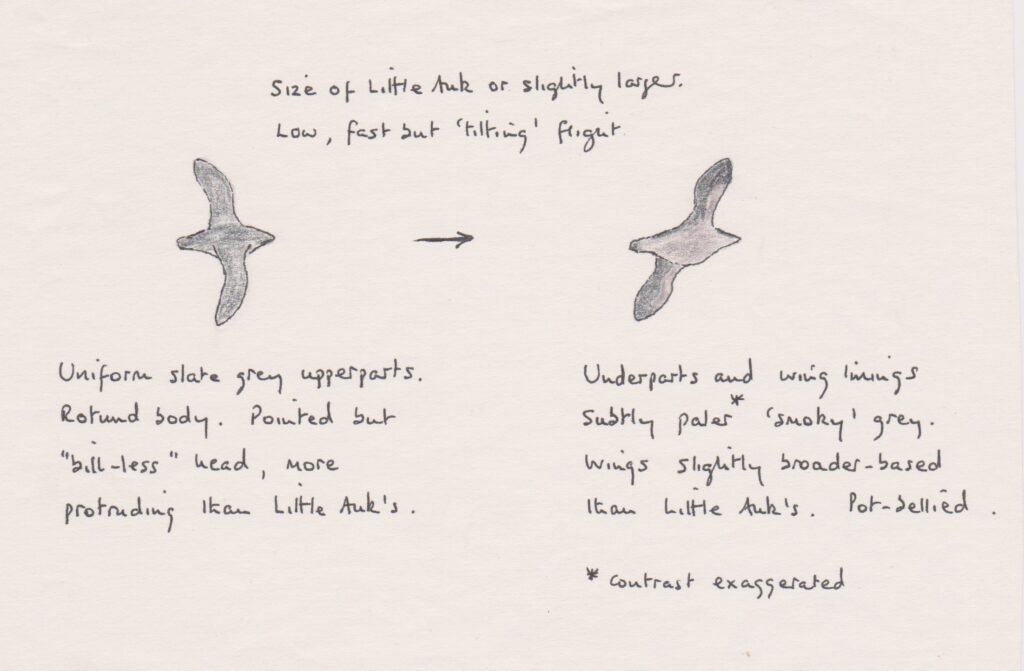

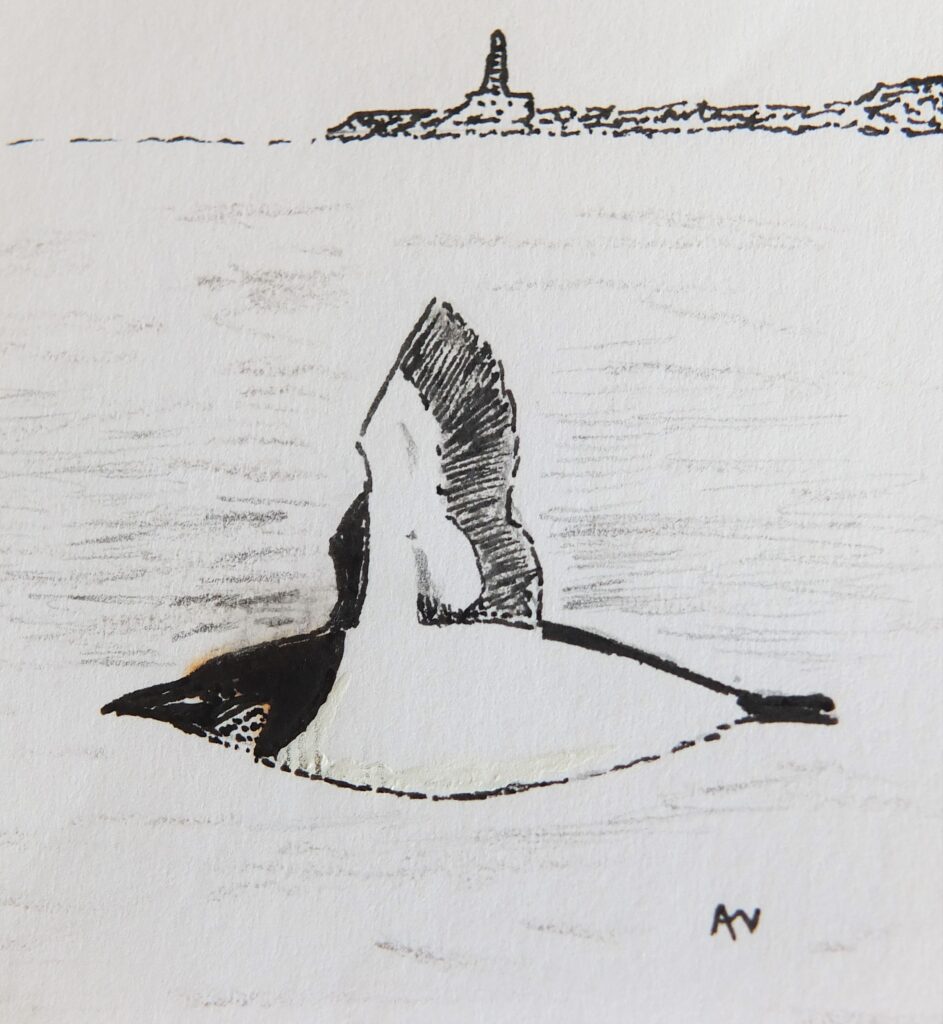
More Pacific auklets can be expected now the North-West Passage is ice free for much longer periods. An immature Tufted Puffin flew west off Salema (my Algarve seawatch point) in late April 2021 and an Ancient Murrelet was recently found in southern Spain. In October 2023 I saw a Pink-footed Shearwater off Salema and a very close Short-tailed in early January 2025, suggesting these are just (inappropriately!) the tip of the iceberg.
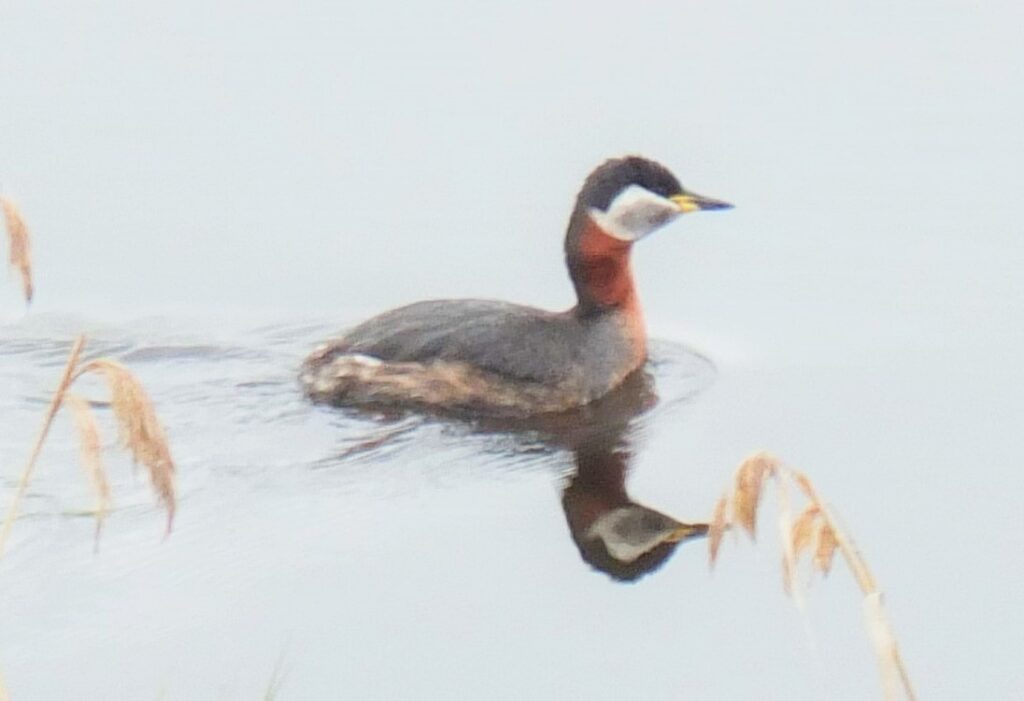
Having seen most of my Red-necked Grebes on the sea or in estuaries in winter, I had come to regard it as a ‘seabird’ but my two most notable encounters were with birds on freshwater. In spring 1964 I visited Barn Elms in London (then just four concrete-sided reservoirs) every morning before work. The highlight of these visits was a stunning Red-necked Grebe in full breeding dress. It soon relocated to Staines Reservoir where it spent the summer. I did not have a camera in those days, so took the opportunity to photograph another at the splendid Siikalahti Reserve in southern Finland in 2012.