Nearctic passerines
Santa Maria’s unmanaged ‘waste’ ground is beloved of America’s ‘stockyard’ birds: White-crowned, White-throated and Song Sparrows. I managed to photograph this Song Sparrow, early one morning in Florida, beside an unmade road near St. Mark’s Refuge, along with White-throated, Lincoln’s and Swamp Sparrow.
I found two Song Sparrows on Santa Maria, in June and December, and two spring birds in the Algarve.
After a very quiet spell on Santa Maria in April 2012, I flushed a flock of sparrows near the north-western tip on 1 May. There was a larger bird with them as they disappeared into a gully in the cliffs. Fortunately, they soon returned, and I was able to photograph their strange companion: a first winter male Bobolink. This was only the second spring record for Europe (one at Gibraltar in May 1984).
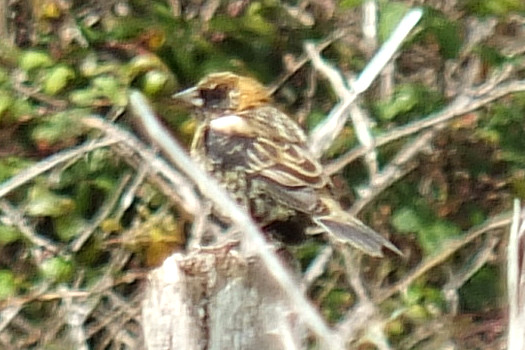
I had to return to the island for administrative reasons early in 2018 and had time to kill on 1 February, waiting for my return flight to Lisbon. There was a cattle pond near the airport and, as I was checking it, a pale, robust bird flew out from the airport escarpment to drink at the pool, perching on nearby brambles before it did so. It was a female Bobolink, which could well have overwintered on the island.
Incredibly, another female visited my Algarve garden on 25 June 2025, escaping down the valley to an area of ungrazed meadow before I could reach my camera.
‘The Birds of the Iberian Peninsula’ (2015) details the occurrences of remarkably few Nearctic passerines in mainland Iberia, a good proportion of which were in spring. Although the authors considered the likelihood of spring arrivals being ship-assisted, their concentration at this season suggests a more natural alternative: the northward movement from Africa of birds displaced across the Atlantic the previous autumn. The Spain/Gibraltar spring records are all of seedeaters: Dark-eyed Junco, White-throated Sparrow, Song Sparrow, Indigo Bunting and Bobolink. My own observations, on both the island of Santa Maria in the Azores and in SW Algarve, support this hypothesis, as I have encountered a total of seven Nearctic seedeaters of three species in spring since 2010, plus a Buff-bellied Pipit.
Given Iberia’s long Atlantic coastline, BIP’s total of only eight Nearctic passerines in autumn (all recorded only once, apart from three Red-eyed Vireos, and none in Portugal) is even more surprising, with lack of coverage in Portugal the most obvious factor. The other species recorded in Spain are Yellow-billed Cuckoo, Common Nighthawk, Buff-bellied Pipit, Fork-tailed Flycatcher, Rose-breasted Grosbeak, Common Yellowthroat and Yellow-rumped Warbler. The only American Robin was, typically, in December.
Portugal is well placed both to receive Nearctic birds direct from North America and southbound ‘filterers’ that found themselves in north-west Europe. In the south, most of the habitats near the west coast would offer only temporary refuge to new arrivals. My conifer-rich valley with a scrub understory, bordered by flower-rich gardens with berry-bearing bushes, is one of the first areas east of Cape St. Vincent with sufficient biodiversity to attract, and hold, a variety of species types. My small garden pools provide the necessary freshwater on an estate full of swimming pools!
Concentrated efforts in recent years in the Azores, mainly on the westernmost island of Corvo, by Peter Alfrey et.al., have demonstrated just how many Nearctic passerines are displaced each autumn. Even on the easternmost island of Santa Maria, I was regularly seeing some, albeit mainly seedeaters which found the unmanaged, weedy terrain there to their liking. The increasing incidence and strength of autumn hurricanes in the western Atlantic is likely to cause ever-larger displacements of migrants bound for Central and South America, as evidenced by the unprecedented ‘fall’ in western Europe in late September 2023, which must have involved thousands of birds. I thought my personal tally of six species in eleven days in my small valley would be a one-off, but three separate arrivals there between late August and mid-October in 2024 produced an even larger return, a pattern which reoccurred, with interest, in 2025.
Hurricanes can account for only some of the multi autumn arrivals in the last three years. Another factor is a change in the ‘Azores High’, which in the past rarely extended more than two thirds of the way across the Atlantic. Now it is extending north and west to the coast of Newfoundland and sometimes beyond. Depressions to the north of it feed a strong westerly or south-westerly airflow capable of deflecting migrants from the northernmost parts of their breeding ranges out over the Atlantic. Drifting with this airflow, which veers south at its eastern edge, can bring them to north-west Iberia.
Spring records in south-west Algarve
When I published details of my sightings in the Algarve from 2016 to 2021 (Vittery, 2022) I had not seen a single Nearctic passerine in either spring or autumn. On 3 April 2022 I was checking the coastal reedbed at Boca do Rio and, with a mixed party of finches by the footpath, there was a Song Sparrow. The frequently cocked tail first drew it to my attention and it allowed close enough approach to see the confirmatory plumage details before it flew off to another weedy area downriver.
On 10 May 2023, I heard an unfamiliar rhythmic song in the valley which proved to be another Song Sparrow. I did not see or hear it again, so it may still have been heading north. On the 18th I was returning from an early morning seawatch at the coastal village of Salema and, on the road just behind the clifftop, there was a Buff-bellied Pipit. It may have crossed from Morocco overnight and been attracted by the village lights.
At 06.45 on 11 June 2025 I was on the track above the Santo Antonio golf course at Budens, just a short walk from my house. A small, dark passerine, hardly larger than a Serin, moved furtively ahead of me through the track-side vegetation. The frequently cocked tail reminded me of Song and Swamp Sparrow, but it was smaller and shorter-tailed than Song Sparrow. When it eventually flew up into denser cover, the tail showed no white and was roundish-ended with just a slight notch in the middle. The visible features were all consistent with Lincoln’s Sparrow, which I had previously seen in Florida and, more recently, Ontario, where a copulating couple gave unusually prolonged views.
It was a forlorn hope that it might find its way to my garden, less than 300m away, but on 25 June 2025 a larger seedeater was ‘sunning’ in a sandy area beside one of my pools. To my astonishment, it was a female Bobolink, with plainish cinnamon-buff underparts (only lightly streaked on the flanks), dark cap, black-streaked brown upperparts with white ‘braces’ and a heavy bill. The tail was spread, revealing the pointed tips to the feathers. It flew back down into the valley, where there is a sizeable, ungrazed meadow, before I could access my camera. The 1st year male I photographed on Santa Maria on 1 May 2012 (Vittery, 2018) was only the second spring record for Europe. I also saw a female there on 1 February 2018, which had probably been overwintering.
Given the numbers of Nearctic passerines now reaching Portugal in autumn (see below) there is an increased likelihood of encountering birds returning north on the ‘wrong side’ in spring.
Autumn records in south-west Algarve
As mentioned in the introduction, I had not seen a single autumn Nearctic passerine in mainland Portugal before 2023, so was totally unprepared for the amazing events of that autumn. The hurricane responsible for the displacement of what must have been most of a night’s migration down the eastern seaboard of North America struck in the last week of September. Given my six sightings spanned an eleven-day period, 29 September – 9 October, it seems likely most involved birds filtering south after arriving further north in western Europe.
First up, on 29 September, was one of the long-tailed ‘blackbirds’, looking rather like a small, dark cuckoo in flight. Of the two possibilities, Rusty seemed the likeliest as it had occurred in Europe before. But this late in the autumn it should have had areas of brown in the plumage and the bird in the eucalypts below my house still looked uniformly dark. The harsh call also indicated it was the less likely Brewer’s Blackbird, which does reach the east coast of the US in autumn.
On 3 October there was a Veery in a neighbouring garden. It flew down into the valley behind the eucalypts, showing palish rufous upperparts contrasting with the conspicuously white belly. Two days later a long-tailed, grey, black and white tit shot low through the garden. Although I suspected its identity, I hesitated to claim a new bird for Europe on such a brief view. Fortunately, it reappeared the next morning, perching on the ridge wires opposite the house and allowing me to ’scope it at leisure. Unmistakably, a Black-capped Chickadee! The following day it did a rapid circuit of the valley conifers before disappearing to the north.
On the second of these days the rotting fruit on a pomegranate tree in the garden was sampled by a Philadelphia Vireo which quickly disappeared behind the eucalypts. That afternoon I went along the valley track searching for it (and the chickadee) and a Tennessee Warbler flew up from scrub in the valley into a tall garden pine. Tail-end Charlie, on the 9th, was a female Scarlet Tanager in a tree at the bottom of my garden. It flew up into the eucalypts and then south down the valley, close past my veranda watchpoint.
2024
After the riches of 2023, I paid more attention to the development of the hurricane season in the west Atlantic in ’24 but considered that ‘Debbie’, which had ravaged the Florida coast in mid-August, was too early to send anything of interest my way. It may have been too early for most migrants but not, apparently, for Florida residents! Early on 17 August a Common Grackle perched briefly on the ridge wires and investigated the roadside spoil heaps below before disappearing back over the ridge. The size, heavy, decurved bill and long, broad tail rendered it unmistakeable. From below, the tail seemed to have two sets of feathers folded over one another. That afternoon a juvenile Cliff Swallow spent about three minutes taking insects around the eucalypts, showing dull blueish upperparts with a brown tinge, dull, pale rump, short tail (almost square-ended), whitish underwings and speckled undertail coverts.
A fresh north-westerly then sprang up and a rotund, mainly dark passerine with a shortish tail and disproportionately large bill flew into it, past the veranda. It was completely off my radar, but reference to the literature confirmed that Seaside Sparrow ticked all the boxes. I can only think the storm surge must have flushed it out of its saltings habitat in Florida and the wind then took it out to sea. The US battle fleet was heading towards the East Mediterranean at the time, so it could have hitched a lift to Portugal!
The second Nearctic influx, in September, was not hurricane related. The static ‘Azores High’ extended further west than usual and strong westerlies at its northern extremity had persisted for some time. The first indication that ‘something was afoot’ was a first winter White-crowned Sparrow flying east on the afternoon of 9 September. Several had reached me in Santa Maria, so this came as no great surprise. But the following morning there was a puzzling greyish warbler with pale supercilia in the garden. Over the next three days I got increasingly good views of it. Diffuse streaking on the underparts and yellowish undertail coverts confirmed it was an Orange-crowned Warbler. On the 12th it was joined by an adult Tennessee Warbler and a thorough ‘recce’ of the valley produced a skulky Yellow-bellied Sapsucker, an Eastern Pewee, looking like a dark Spotted Flycatcher with double wing bars and a Red-eyed Vireo. I saw nothing new on 14/15th but on the 16th my pomegranate tree scored again with a stunning yellow Wilson’s Warbler, which soon reverted to the nearby eucalypts.
Then it was ‘blackbird’ time again! The bird I first saw on 17 September looked almost as dark as the ’23 Brewer’s, but the bill was longer and slightly decurved, confirming Rusty. It remained in the valley for several days and, on the 21st, was joined by a second bird with more brown in the plumage, including broad brown eyebrows.
Strong westerlies and heavy rain in mid-October promised well and delivered spectacularly on the 17th in the shape of a yellow-bedecked female or first winter American Redstart which arrived over the ridge from the east and disappeared into a luxuriant garden at the north end of the valley. It must have found rich pickings there as, four days later, it flew over me, heading south-west, giving a high pitched, two-note buzzing call. The 17th also saw another Red-eyed Vireo in the valley.
2025
The first serious weather event in the Atlantic was storm ‘Floris’, which reached the north of Scotland on 4 August. As in 2023, I considered this too early to have any effect locally but, also as in 2023, I saw three Nearctic species two days later: another juvenile Cliff Swallow, an Eastern Phoebe on the ridge wires, sporting dark patches at the sides of the upper breast but lacking wing bars, and an American Mourning Dove, which flew up from the valley bottom and left to the south. On the 13th, after a spell of easterlies, there was a Red-breasted Nuthatch in a pine in my neighbour’s garden. On plumage, Algerian, is somewhat similar but the very small size and short, fine bill ruled out that even more unlikely possibility. This bird may well have arrived with the other Nearctics on the 6th and remained in the area unseen, or it could have arrived further north and filtered south into my patch.
In late August, Hurricane Erin remained too far offshore to displace birds from the eastern seaboard of the US, but in early September the ‘Azores High’ extended right across the Atlantic from beyond the coast of Newfoundland to the longitude of the Iberian west coast. There was a strong south-westerly airflow along its northern edge. About a kilometre north of Budens on 6 September I flushed an American Robin from the side of the dirt road and two days later there was a Yellow-rumped Warbler in the valley, which soon left to the west.
With the Azores High still extending inland beyond the coast of Newfoundland there was a second arrival in mid-September. On the 14th a smallish Dendroica warbler with prominent double wing bars filtered south-west across the valley and along my garden hedge. Although it gave only brief views perched, the slim body and longish tail confirmed it was a Blackburnian Warbler. In the late afternoon of the 15th my third Rusty Blackbird dropped down into the valley from the south-west, showing extensive brown areas in the flight feathers. A 1st winter Baltimore Oriole must also have arrived that day as I saw it leaving the eucalypts below my house early the next morning and again on the 17th, on each occasion disappearing into luxuriant gardens at the north end of the valley. On the morning of the 18th it left to the south, flying past my veranda just 15m away.
The 16th had produced another mega – a 1st winter Rose-breasted Grosbeak flying powerfully south-west about 50m above ground level with pronounced, shortish undulations. Larger and heavier than Corn Bunting, the streaky brown plumage, bold head pattern, lack of rufous in the plumage and the flight action ruled out the only other species with similar dimensions – Fox Sparrow.
Early on the morning of 25 September a Bobolink flew south over the ridge. The powerful, direct fight, large size, plump, short-tailed ‘jizz’ and rich buffish underparts ruled out any European possibilities. It was followed soon afterwards by a Tree Swallow. The dark brown upperparts contrasted sharply with pure white underparts, the white vent showing a small extension onto the sides of the rump. It was flying behind a Red-rumped Swallow and was slightly bulkier, with broader wings.
Two hurricanes moved north along the US seaboard in late September, merging as ‘Amy’ and reaching Britain in early October. On 3 October a Palm Warbler passed through my garden, showing the longish tail and bright yellow undertail coverts unique to this species. Two days later my third Tennessee Warbler was a first winter bird with yellow underparts, in exactly the same spot at the northern end of the valley as the first in 2023! This was quickly eclipsed by Europe’s first Blue-headed (Solitary) Vireo. Typically sluggish, plump and short-tailed, it moved slowly through a stand of tall Bupleurum rigidum, showing its dramatic head pattern (dark with broad white lores connected to a white eye-ring) and two white wing bars.
Two days after ‘Storm Benjamin’ hit France, an unmistakable male Purple Martin cruised elegantly south-west on the morning of 25 October. Starling-sized, the flight action was more languid than any other hirundines’.
A vigorous Atlantic front moved through Portugal on the night of 4/5 November. This may have been responsible for my second Wilson’s Warbler (1st W or female) which filtered south-west through the valley/garden on the 7th, following the same line as the October Blackburnian but, unlike that bird, keeping to the hedge tops. Only Chiffchaff-sized, it was plain olive-green above and yellow below, lacking wing-bars or white in the tail. Incredibly, my seventeenth Nearctic passerine of the autumn!
| *denotes stays of 3+ days | |||
| August | |||
| 2024 | Cliff Swallow | ||
| Common Grackle | |||
| Seaside Sparrow | |||
| 2025 | Am. Mourning Dove | Red-breasted Nuthatch | |
| Cliff Swallow | |||
| Eastern Phoebe | |||
| September | |||
| 2023 | Brewer’s Blackbird | ||
| 2024 | Orange-cr Warbler* | Yellow-b Sapsucker | Rusty Blackbird* (2nd) |
| White-crowned Sparrow | Eastern Pewee | ||
| Red-eyed Vireo | |||
| Tennessee Warbler | |||
| Wilson’s Warbler | |||
| Rusty Blackbird* | |||
| 2025 | American Robin | Rose-breasted Grosbeak | Bobolink |
| Yellow-rumped Warbler | Blackburnian Warbler | Tree Swallow | |
| Rusty Blackbird | |||
| Baltimore Oriole* | |||
| October | |||
| 2023 | Veery | ||
| Philadelphia Vireo | |||
| Black-cap Chickadee* | |||
| Tennessee Warbler | |||
| Scarlet Tanager | |||
| 2024 | Red-eyed Vireo | ||
| American Redstart* | |||
| 2025 | Palm Warbler | Purple Martin | |
| Tennessee Warbler | |||
| Blue-headed Vireo | |||
| November | |||
| Wilson’s Warbler | |||
It is clear a dramatic change has occurred in recent years. My sightings at just one location in the Algarve suggests the actual arrivals in Iberia and elsewhere in western Europe must also have been much more numerous. My conclusion is that the extension of the ‘Azores High’ to Newfoundland in autumn has created a new vector for night migrants leaving the northern extremities of their breeding ranges in North America. Not only are their numbers increasing year-on-year, but arrivals are occurring both earlier and later in the autumn. So, if this pattern persists, many more can be expected in future years, irrespective of the random influences of hurricanes.